3D point cloud models suffer significant performance degradation under distribution shifts caused by sensor noise, occlusions, and environmental changes. Test-time adaptation (TTA) has emerged as a practical paradigm for mitigating this issue during inference. Recently, leveraging multi-view augmentation has shown promise in improving 3D TTA performance. However, existing multi-view approaches are often constrained by sequential optimization that treats each view independently. This sequential optimization leads to substantial inference latency due to repetitive optimization steps, making real-time adaptation impractical.
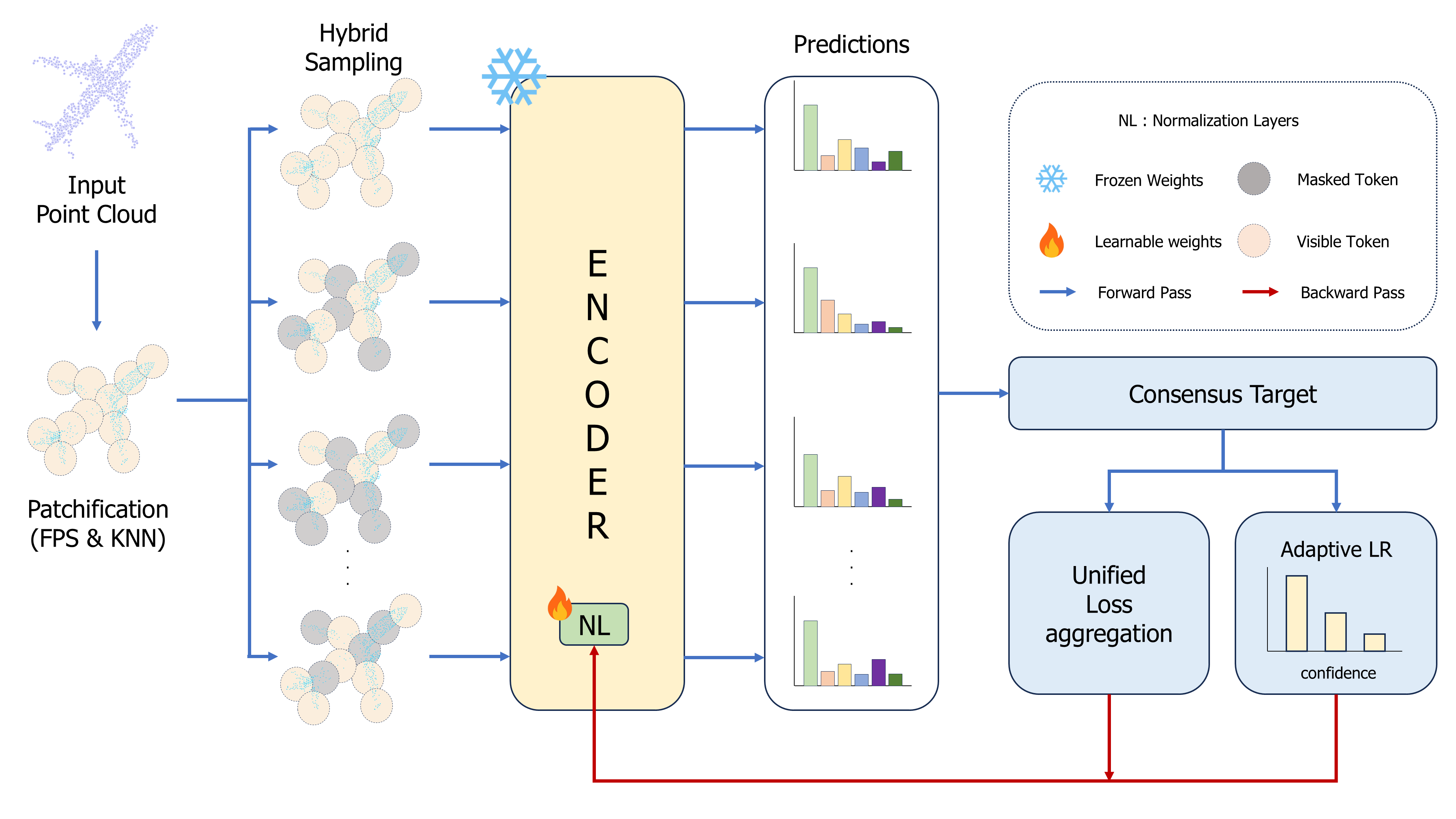
To address this, we propose Masked Multi-View Test-Time Adaptation (MAMVI), which replaces sequential optimization with a unified single-step adaptation. Specifically, MAMVI utilizes a hybrid masking strategy that combines fixed ratios for stability with Beta-distributed sampling for diversity. By aggregating losses across multiple views, MAMVI performs adaptation through a single backward pass based on multi-view consensus. Additionally, a confidence-based adaptive learning rate is used to dynamically adjust the adaptation intensity for each sample. Extensive experiments on ModelNet-40C, ShapeNet-C, and ScanObjectNN-C demonstrate that MAMVI achieves state-of-the-art accuracy on ShapeNet-C and ScanObjectNN-C. Moreover, it remains competitive on ModelNet-40C while delivering 4.9–8.9 times faster inference, making it highly suitable for real-time applications.
Prior multi-view 3D TTA methods repeatedly optimize parameters view-by-view sequentially, causing severe latency. MAMVI unifies multi-view predictions and optimizes through a single backward pass based on consensus across views, drastically reducing adaptation overhead.
MAMVI introduces a hybrid point masking scheme: fixed masking ratios preserve canonical geometric structures for stable consensus, while Beta-distributed stochastic sampling injects geometric diversity to prevent collapse under severe corruptions.
Instead of using a uniform learning rate, MAMVI dynamically scales the step size on each sample conditioned on the model's prediction confidence, effectively preventing error accumulation on ambiguous and out-of-distribution point clouds.
| Method | ModelNet-40C | ShapeNet-C | ScanObjectNN-C |
|---|---|---|---|
| Source Only | 54.13 | 61.35 | 36.96 |
| TENT | 63.65 | 61.01 | 45.97 |
| SAR | 64.12 | 61.46 | 47.26 |
| MEMO | 68.18 | 64.30 | – |
| PG-SF | 68.68 | 64.40 | 47.54 |
| SVWA | 75.04 | 65.74 | 47.45 |
| MAMVI (Ours) | 74.80 | 66.77 | 49.76 |
Top-1 accuracy (%) averaged over 15 corruption types, compared with source-free TTA methods on a Point-MAE backbone. Best and second best are marked. Per-corruption results are in the paper.
| Method | ModelNet-40C | ShapeNet-C | ScanObjectNN-C |
|---|---|---|---|
| SVWA | 8.99 | 8.63 | 9.03 |
| MAMVI | 77.10 | 76.64 | 44.50 |
| Speedup | 8.6× | 8.9× | 4.9× |
Compared with the multi-view method SVWA, MAMVI gives similar or better accuracy at 4.9–8.9× the throughput.
| Setting | MN-40C | SN-C | SO-C |
|---|---|---|---|
| No ALR | 73.86 | 65.63 | 49.33 |
| With ALR | 74.80 | 66.77 | 49.76 |
| Gain | +0.94 | +1.14 | +0.43 |
Confidence-based ALR improves accuracy on all three benchmarks.
@inproceedings{kong2026mamvi,
  title={MAMVI: 3D Test-Time Adaptation via Masked Multi-view Point Clouds},
  author={Kong, Inseok and Jung, Geunyoung and Jung, Jiyoung},
  booktitle={International Conference on Pattern Recognition},
  pages={348--362},
  year={2026},
  organization={Springer}
}