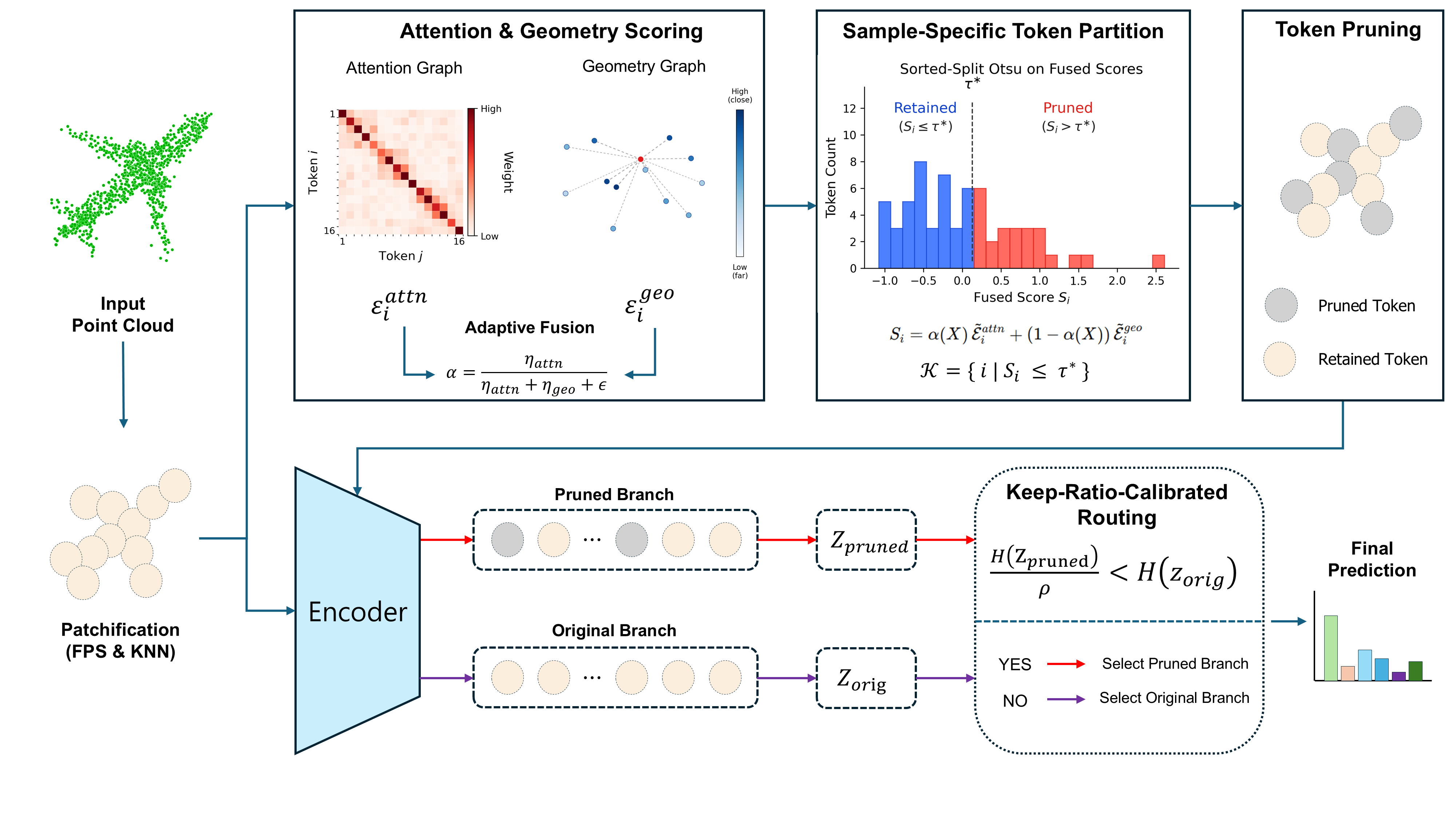
Test-time adaptation (TTA) mitigates the performance degradation of source-pretrained models on unlabeled test data under distribution shifts. Recent backpropagation-free token-purging methods address 3D point cloud distribution shifts by filtering unreliable tokens. However, their reliance on predefined purge-size candidates requires multiple forward passes per sample and increases inference cost.
We propose SATOR (Sample-Adaptive TOken Routing), a source-free and backpropagation-free 3D TTA framework that eliminates this search by deriving both the partitioning threshold and routing decision directly from each sample. SATOR computes token abnormality scores from complementary attention and geometric relation graphs. It then derives a sample-specific partition into retained and pruned tokens via Otsu-based separability, without evaluating candidate sizes. Keep-ratio-calibrated routing then selects the pruned prediction only when its entropy, penalized by the keep ratio, is lower than that of the original prediction. Extensive experiments on ModelNet40-C, ScanObjectNN-C, and ShapeNet-C demonstrate that SATOR achieves state-of-the-art accuracy on three 3D corruption benchmarks.
Conventional 3D TTA approaches rely on gradient-based backpropagation during inference, incurring excessive computational cost and memory footprints. SATOR operates completely without backward passes or source data, making it highly suitable for resource-constrained edge systems.
Instead of relying on stored global statistics or self-attention alone, SATOR synergizes internal self-attention maps with spatial geometric relation graphs ($K_g$-NN affinity) to quantify how corruptions disrupt local neighborhood structures and reliably score abnormal tokens.
Prior token-purging methods evaluate multiple predefined purge-size candidates through iterative forward passes. SATOR completely eliminates candidate search by deriving an optimal sample-specific threshold directly from the score distribution via Otsu-based separability.
SATOR compares predictions from the original sequence and the pruned sequence. To prevent low entropy from being favored solely due to aggressive token reduction, it calibrates prediction entropy by the keep ratio ($\rho = |\mathcal{K}|/M$), selecting the pruned branch only when $\frac{H(z_{\mathrm{prune}})}{\rho} < H(z_{\mathrm{orig}})$.
| Method | Venue | ModelNet40-C | ShapeNet-C | ScanObjectNN-C |
|---|---|---|---|---|
| Source-only | – | 54.16 | 61.35 | 36.96 |
| TENT | ICLR'21 | 63.53 | 54.98 | 43.45 |
| SAR | ICLR'23 | 59.64 | 60.17 | 48.78 |
| BFTT3D | CVPR'24 | 57.16 | 60.73 | 33.00 |
| PG | ICCV'25 | 68.68 | 64.40 | 46.78 |
| LN-TTA | WACV'26 | 69.71 | 64.35 | 48.50 |
| SATOR (Ours) | – | 70.26 (+16.10) | 64.92 (+3.57) | 49.43 (+12.47) |
Top-1 accuracy (%) averaged over 15 corruption types. Values in parentheses are gains over source-only. Best and second best are marked. Full per-corruption results and more baselines are in the paper.
| Method | Acc. (%) | FPS | Mem. (GB) |
|---|---|---|---|
| BFTT3D | 33.00 | 55.9 | 8.77 |
| PG | 46.78 | 174.1 | 1.38 |
| LN-TTA | 48.50 | 790.0 | 1.38 |
| SATOR | 49.43 | 483.2 | 1.38 |
Skipping the purge-size search makes SATOR about 2.8× faster than PG, with higher accuracy and the same memory use.
| Score | AUROC | AP |
|---|---|---|
| Attention only | 0.751 | 0.765 |
| Geometry only | 0.794 | 0.683 |
| Adaptive fusion | 0.839 | 0.783 |
On background corruption (ScanObjectNN-C), fusing the attention and geometry scores locates corrupted tokens best.
@inproceedings{kong2027sator,
  title={SATOR: Backpropagation-Free 3D Test-Time Adaptation via Sample-Adaptive Token Routing},
  author={Kong, Inseok and Jung, Geunyoung and Jung, Jiyoung},
  booktitle={IEEE/CVF Winter Conference on Applications of Computer Vision (WACV)},
  year={2027}
}