Abstract
Multimodal LLMs suffer from cross-modal hallucination: one modality interferes with generation about another, such as a video making the model “hear” a sound that is not in the audio. The authors argue this is not a representation problem inside each modality. The model fails to control how the modalities influence each other. The question to answer is: for this question, how much should the model trust audio, and how much video?
Existing contrastive decoding (CD) methods use a fixed contrastive strength for every question. MAD asks the model one extra question: does this question need audio, video, or both? It turns the answer into per-branch weights in a four-branch CD formula. It needs no training.
Motivation
The paper opens with a concrete failure. Asked to describe a video and its sound, a base audio-visual LLM makes up visual content and, worse, makes up sounds that fit the scene: a man next to a boat becomes someone giving fishing tips, and the audio supposedly contains “the occasional splash of a fish jumping out of the water”. The strong visual cues have leaked into the audio description.
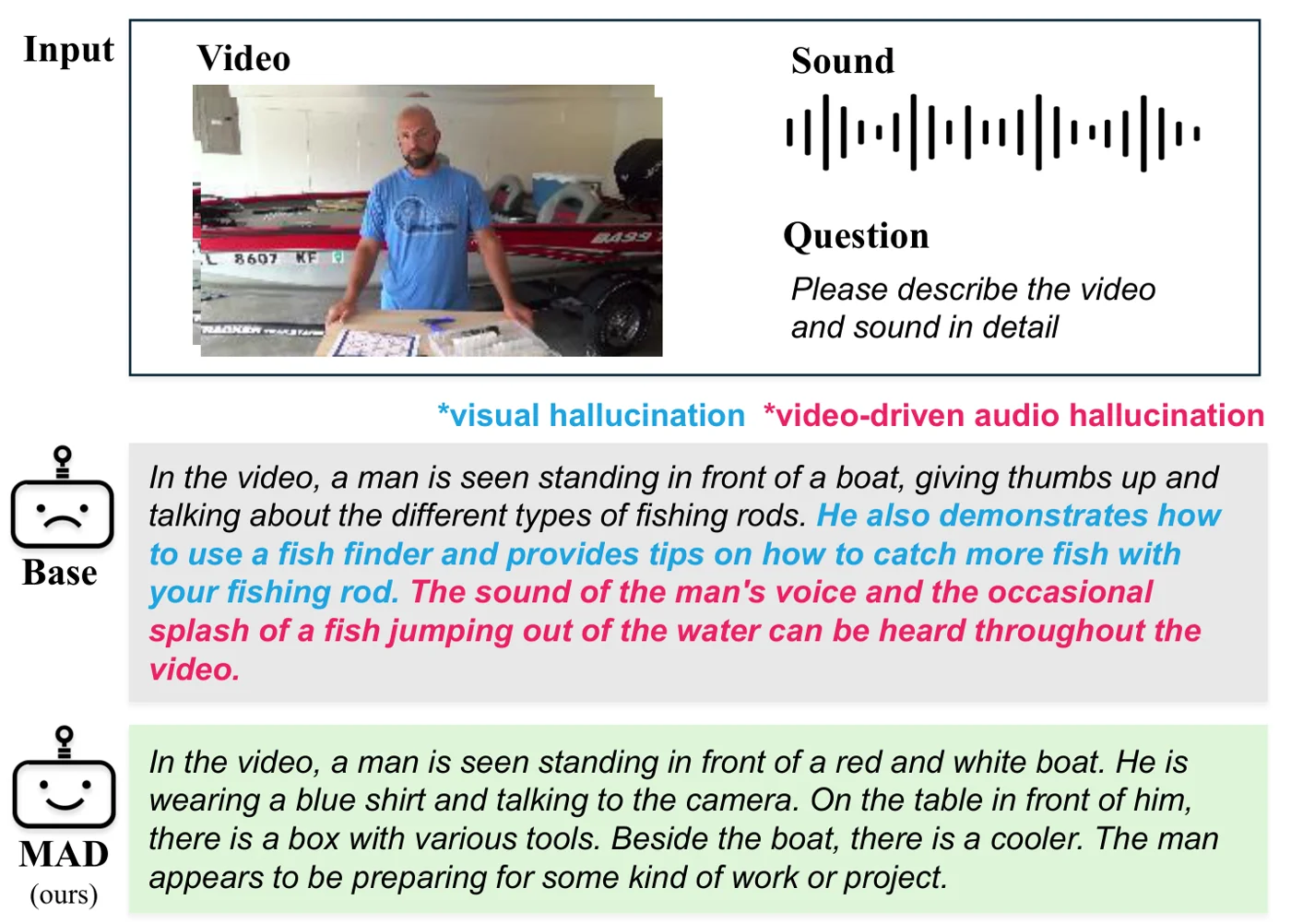 A video of a man in front of a boat with the prompt “describe the video and sound in detail”. The base model adds visual hallucinations (blue) and video-driven audio hallucinations (red), such as fish splashes. MAD’s description stays with what is actually there. Figure from the paper.
The authors argue this is not a weak encoder for one modality but a failure of modality-interaction control: the model has to judge which modality is reliable and relevant for the task, and keep the others from leaking in. Existing training-free fixes do not do that. VCD-style contrastive decoding assumes hallucination comes from the visual input, and AVCD extends CD to audio and video but applies the same distortion and strength to every modality, no matter what the question asks. The insight behind MAD is that the model itself can say which modality a question needs, and that this self-assessment can steer how strongly each contrastive branch is applied.
Method
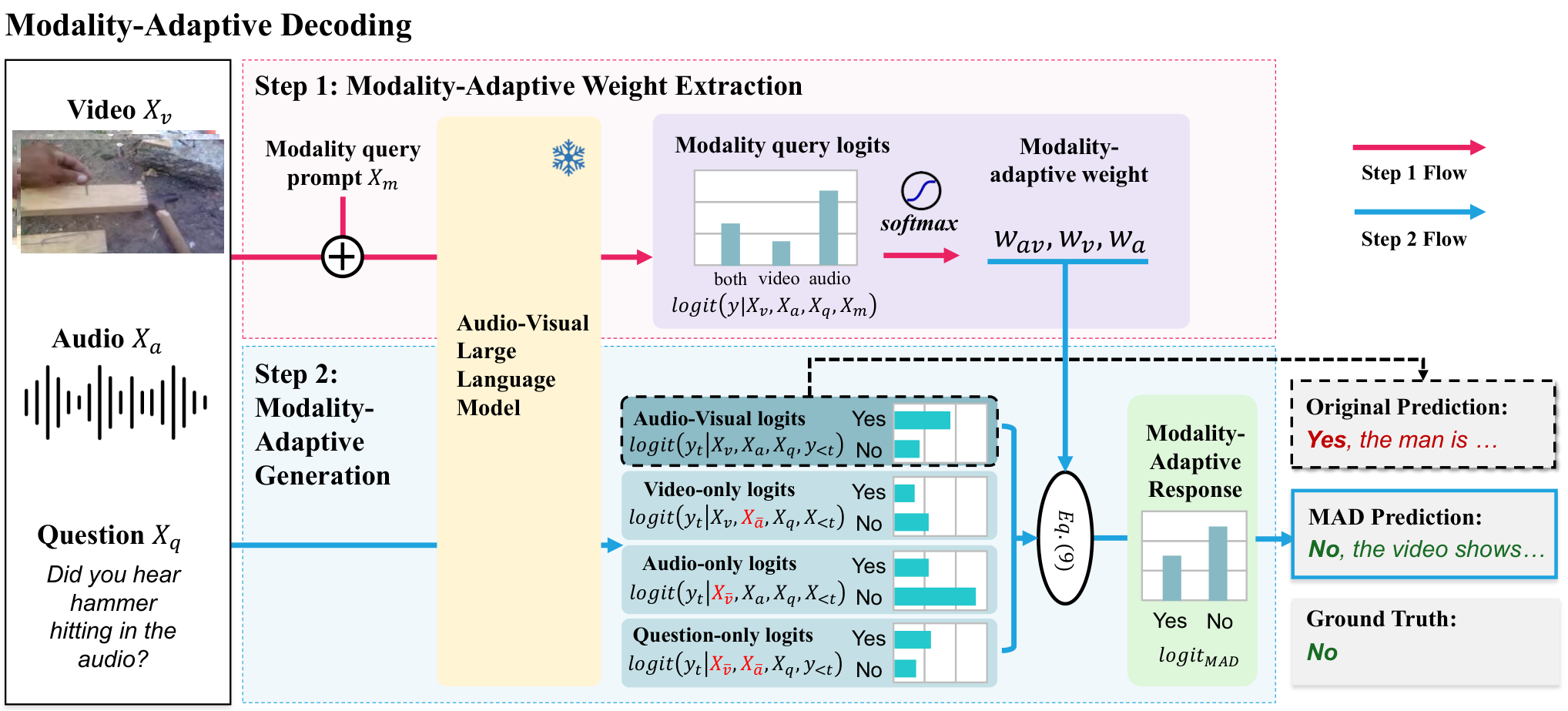 MAD in two steps. Step 1 extracts modality weights from a modality query prompt. Step 2 combines four branch logits with those weights. Figure from the paper.
Weighted contrastive decoding
For modality \(m\), the contrastive signal is the logit with \(X_m\) minus the logit with a degraded \(\tilde X_m\), for example \(\Delta_a = z(A) - z(\tilde A)\). MAD splits the contrastive strength into two factors:
\[\mathrm{logit}^{(m)}(y_t) = \mathrm{logit}(y_t \mid X_m, X_q, y_{<t}) + \gamma\, w_m \Delta_m\]Here \(\gamma\) is the global strength and \(w_m\) is how important modality \(m\) is for this question.
Step 1: Modality-adaptive weight extraction (top)
The model gets the input plus a modality query prompt \(X_m\) asking which modality the question needs. It does not generate an answer. MAD reads the next-token logits of three candidate words and applies a softmax:
\[[w_{av}, w_v, w_a] = \mathrm{softmax}\big([z_{\text{both}}, z_{\text{video}}, z_{\text{audio}}]\big)\]The weights follow the question type. Averaged over the benchmark, visual questions get \(w_v = 0.565\), audio questions get \(w_a = 0.482\), and audio-visual questions get \(w_{av} = 0.464\).
Step 2: Modality-adaptive generation (bottom)
Like AVCD, MAD uses four branches: audio-visual \(z_{VA}\), video-only \(z_{V\tilde A}\), audio-only \(z_{\tilde V A}\), and question-only \(z_{\tilde V \tilde A}\). They form a square, and each edge is one CD term: visual CD with audio present or absent, and audio CD with video present or absent. The terms taken with the other modality present use \(w_{av}\), and the terms taken with it absent use \(w_v\) or \(w_a\). Summing the four terms and collecting coefficients gives Eq. (9) in the figure:
\[z_{\text{MAD}} = (2 + 2\gamma w_{av})\, z_{VA} + (1 - \gamma w_{av} + \gamma w_a)\, z_{\tilde V A} + (1 - \gamma w_{av} + \gamma w_v)\, z_{V \tilde A} - \gamma (w_v + w_a)\, z_{\tilde V \tilde A}\]In the figure’s example, the question asks about a hammer sound. The weights favour audio, the audio-only branch says “No”, and MAD flips the original “Yes” to the correct “No”.
Main Experiments
CMM reports accuracy on visual-dominant, audio-dominant, and language-dominant subsets. AVHBench reports accuracy on video-driven audio hallucination and audio-driven video hallucination.
| Model | Visual Dom. | Audio Dom. | Lang. Dom. | CMM Overall | V→A Hall. | A→V Hall. | AVHBench Overall |
|---|---|---|---|---|---|---|---|
| VideoLLaMA2-AV | 71.8 | 80.0 | 68.8 | 73.5 | 75.7 | 79.0 | 77.4 |
| + VCD (extended) | 71.3 | 83.3 | 74.8 | 76.4 | 66.0 | 74.8 | 70.4 |
| + AVCD | 71.8 | 84.0 | 71.5 | 75.8 | 78.3 | 80.3 | 79.3 |
| + MAD | 82.3 | 84.3 | 77.5 | 81.3 | 79.7 | 79.1 | 79.4 |
| Qwen2.5-Omni-7B | 64.5 | 72.3 | 81.3 | 72.7 | 73.0 | 80.7 | 76.9 |
| + VCD (extended) | 62.5 | 71.3 | 84.5 | 72.8 | 70.3 | 77.1 | 73.7 |
| + AVCD | 66.3 | 72.8 | 81.0 | 73.3 | 75.8 | 79.7 | 77.8 |
| + MAD | 76.8 | 84.3 | 83.3 | 81.4 | 78.7 | 84.4 | 81.6 |
- The biggest jump is on CMM visual-dominant questions: +10.5 for VideoLLaMA2-AV and +12.3 for Qwen2.5-Omni. AVCD barely moves that column.
- Weighting by the full softmax (81.3) beats equal weights (79.4) and putting all weight on the argmax (78.7).
- MAD does not hurt general audio-visual understanding on VideoLLaMA2-AV: OmniBench 36.3 → 36.8, WorldSense 23.3 → 25.6, MUSIC-AVQA 78.1 → 79.1.
The weights themselves look sensible. On 300 hand-made questions over 100 VideoMME videos (100 visual, 100 audio, 100 audio-visual), the largest average weight always lands on the modality the question type needs.
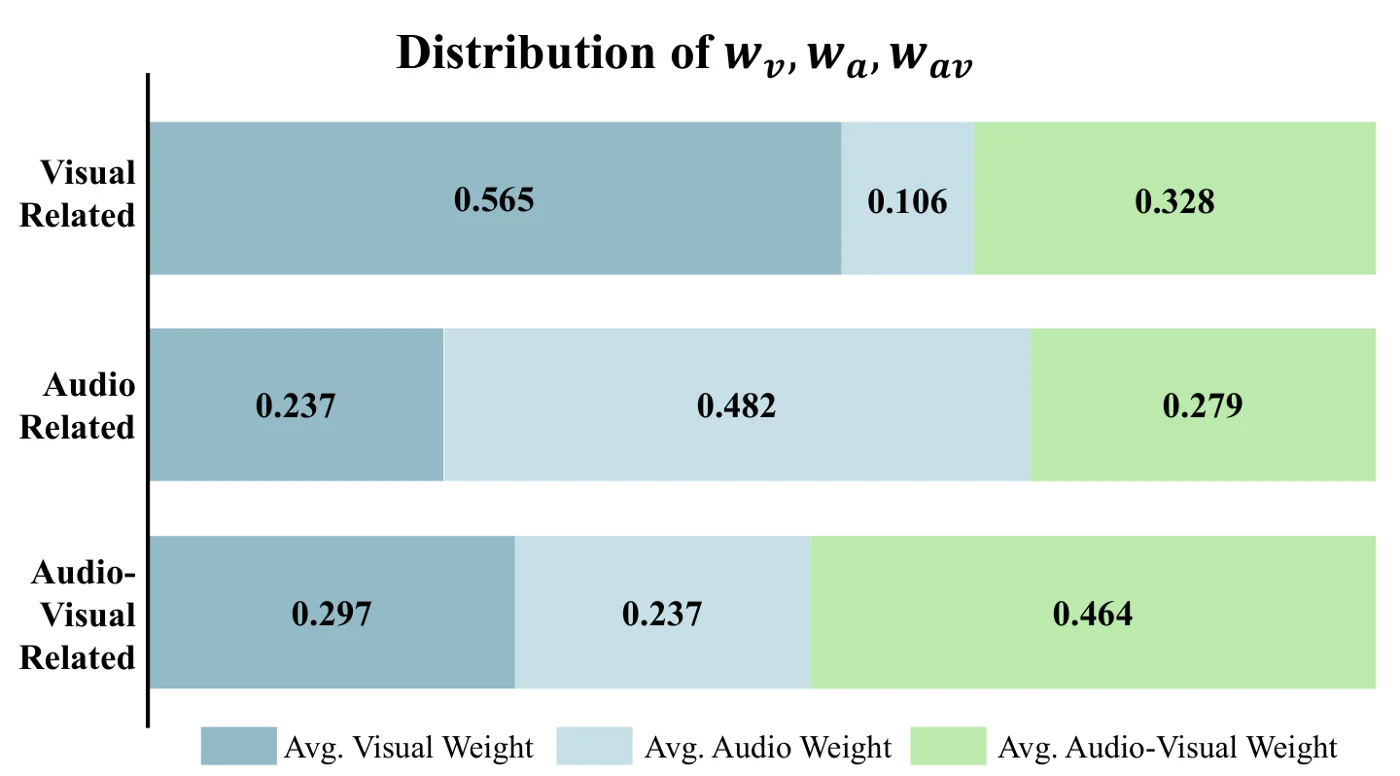 Average \(w_v\), \(w_a\), \(w_{av}\) per question type. Visual questions put most weight on video (0.565), audio questions on audio (0.482), and audio-visual questions on both (0.464), with no supervision. Figure from the paper.
The supplement repeats this on CMM with VideoLLaMA2-AV. The pattern is the useful one for hallucination: when vision dominates and the risk is an audio hallucination, the model puts most weight on audio, and the reverse for audio-dominant cases.
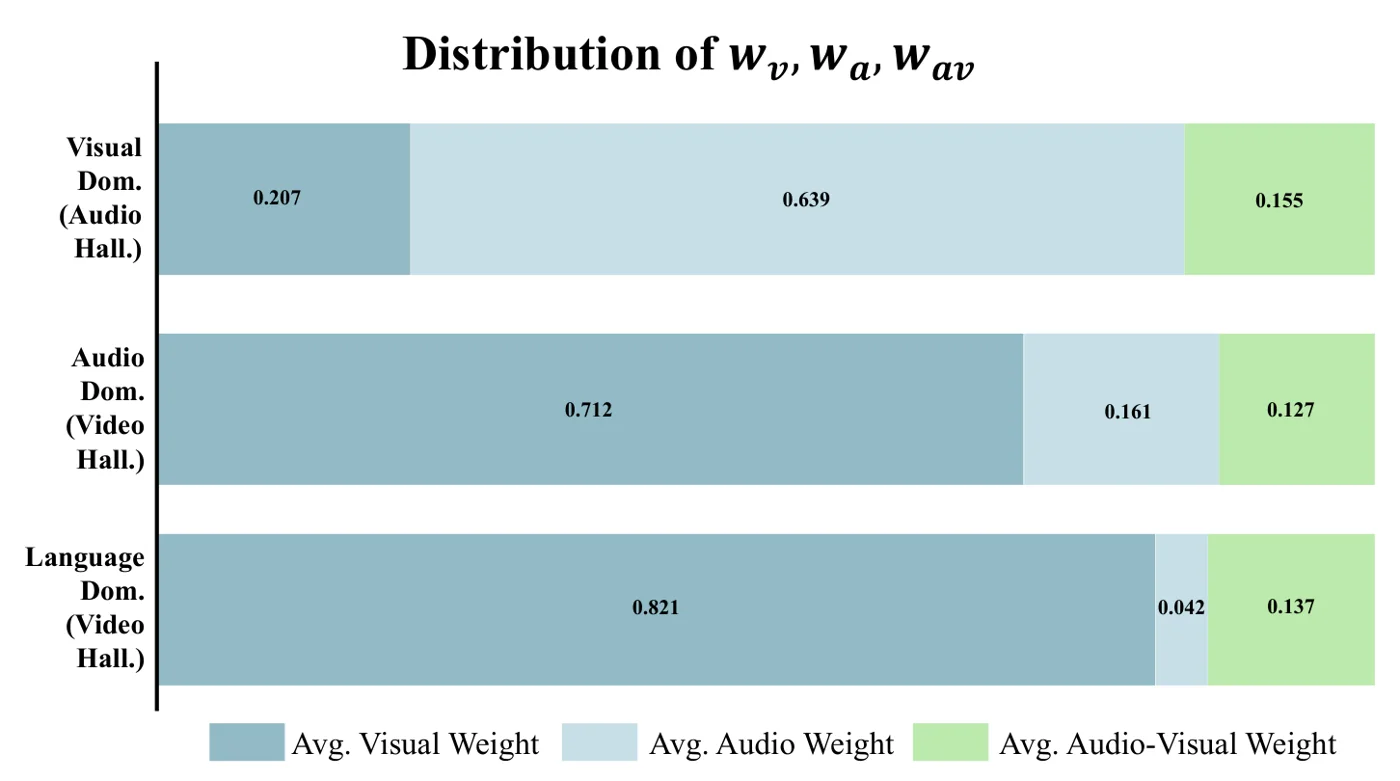 Weights on CMM. Visual-dominant questions (audio hallucination) get \(w_a = 0.639\), while audio-dominant and language-dominant questions (video hallucination) get \(w_v = 0.712\) and \(0.821\). Figure from the paper.
The global strength \(\gamma\) is swept from 0.5 to 3.0. Accuracy rises steeply up to about 2.0 and then flattens, and \(\gamma = 2.5\) is used everywhere.
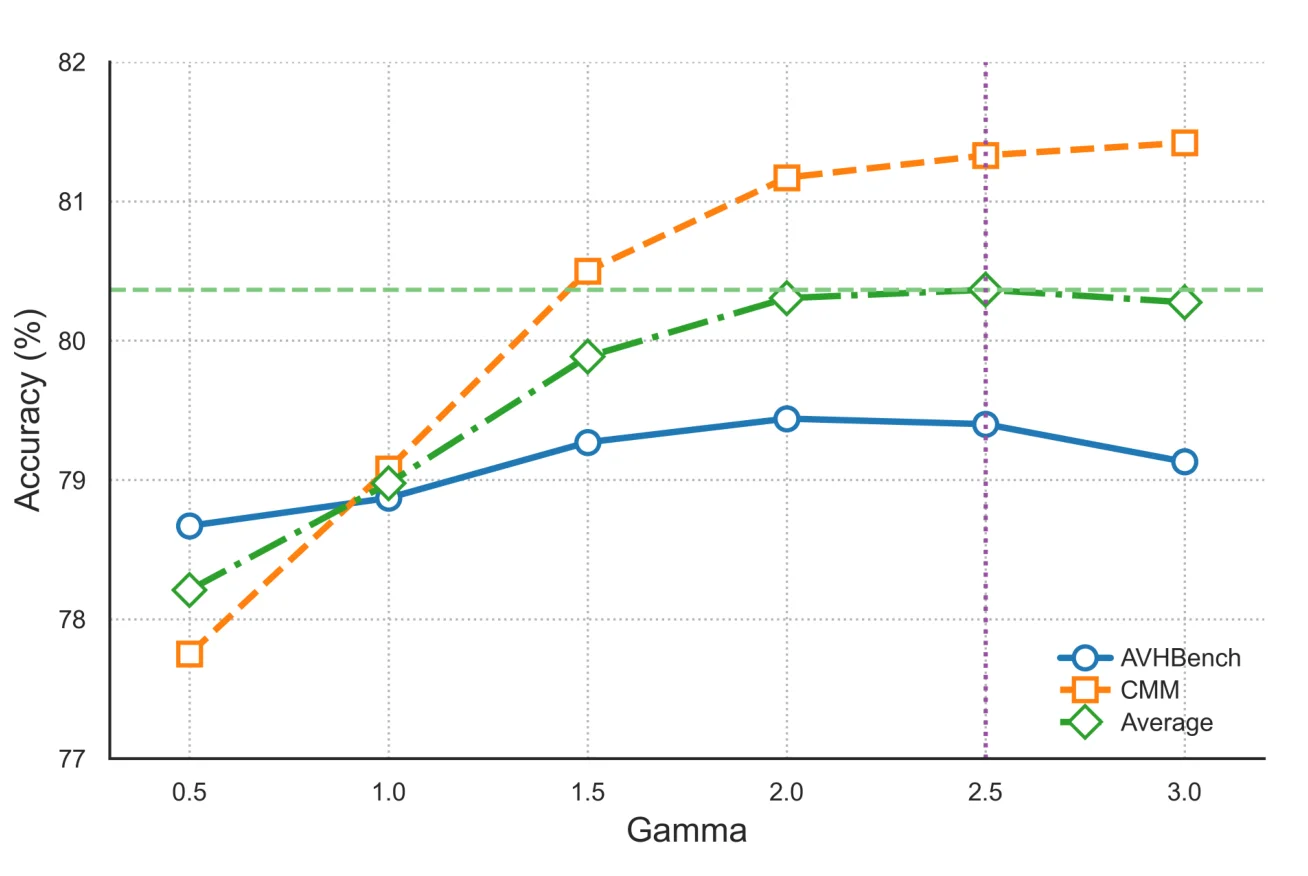 Accuracy on AVHBench, CMM, and their average as \(\gamma\) varies, for VideoLLaMA2-AV. CMM benefits most from a larger \(\gamma\), AVHBench peaks around 2.0, and the average is flat between 2.0 and 3.0. Figure from the paper (supplement).
Limitations
- Cost. Each token needs the four branches, plus one extra pass with the modality query prompt.
- Relevance is not agreement. The weights say which modality is relevant, not whether the unimodal branches agree with the joint prediction. Two relevant modalities can still conflict, and MAD cannot detect that.
- The self-assessment must be right. If the model misjudges which modality a question needs, the weights push the decoding the wrong way.